
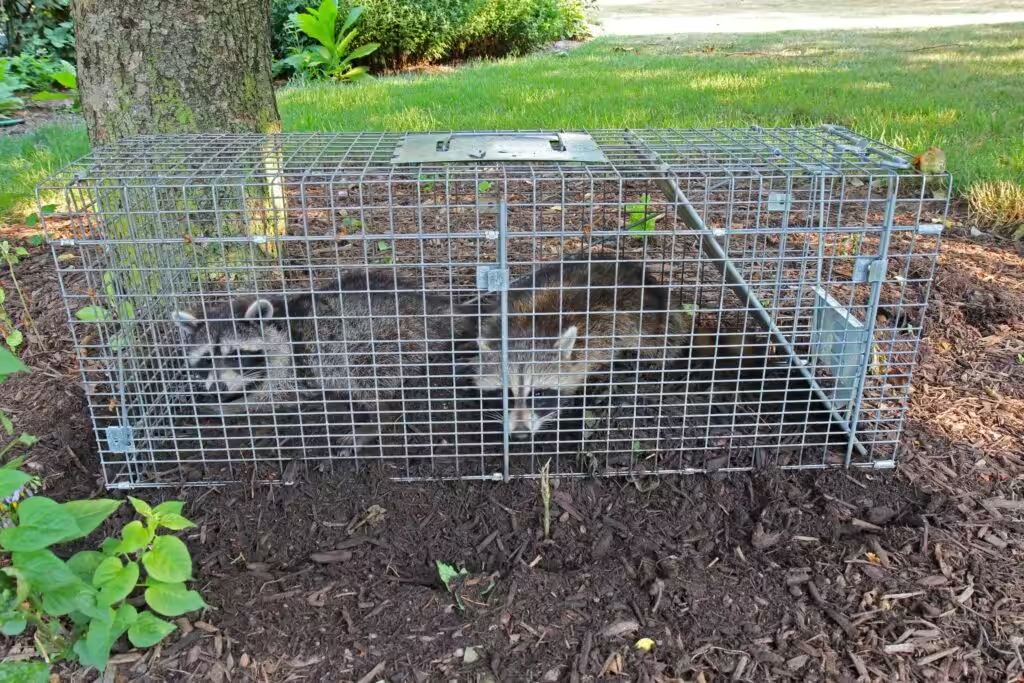
Most homeowners don’t figure it out from a sighting. They figure it out at 2 a.m., when something heavy starts moving around above the bedroom ceiling.
Raccoons are strong, smart, and persistent. Once they find a way in, your attic becomes a den, and in the Midwest, where late spring through summer is peak denning season, this happens more than most people expect. If you’re hearing sounds you can’t explain, there’s a decent chance something’s living up there. Here’s what to look for, and what happens when we come out to handle it.
How to Tell If Raccoons Are in Your Attic
Raccoons aren’t quiet tenants. The signs tend to stack up fast once you know what you’re listening and looking for.
Sounds and Smells That Give Them Away
The clearest early signal is sound. Raccoons are heavier than squirrels or mice; you’ll hear thumping, rolling, and what sounds like something dragging across the attic floor. They’re most active at dusk and through the night, so the noise usually starts right around when the house quiets down.
Smell is the other giveaway. Raccoon urine and droppings accumulate quickly in an enclosed space, and once that odor works its way through the ceiling into living areas, it’s hard to mistake for anything else. If you’re noticing an ammonia-like smell in a room directly below the attic, something’s been up there for a while.
A few other things to look for:
- Grease marks or dark smudging around roofline gaps where fur repeatedly rubs through
- Insulation pulled away from the attic hatch or displaced in large clumps
- Droppings near the entry point, which look similar to small dog waste
- Visible damage to roof trim boards, soffit panels, or vents along the roofline
The smudge marks in particular are easy to miss. Oil from a raccoon’s coat builds up along any gap they’re using regularly. Once you see it on the fascia (the trim board along the roof edge) or soffit (the panel on the underside of the roof overhang), you’ve usually found your entry point.
What Raccoons Do in Your Attic
The noise is the easy part. When we pull back the insulation and show homeowners what’s there, the damage is what catches them off guard.
The Structural and Health Risks
Raccoons don’t confine themselves to one corner. They move around, tear into insulation for nesting material, and chew. Wiring is a particular problem; raccoon teeth can work through standard electrical cable, and damaged wiring in an enclosed attic space is a fire risk. We’ve seen situations where a raccoon had been in an attic for only a few weeks and the insulation damage alone ran into several thousand dollars to restore.
The health side is serious too. Raccoon droppings can carry Baylisascaris, a roundworm parasite that poses genuine health risks to people and pets. The feces dry out over time, and disturbing them, even opening the attic hatch, can release particles into the air. That’s one of the main reasons we don’t recommend homeowners try to clean up an active raccoon situation on their own.
If you’ve been in the attic recently without knowing something was living there, mention that when you call. It affects how we handle the cleanup side of the job.
How Raccoon Removal from Attic Works
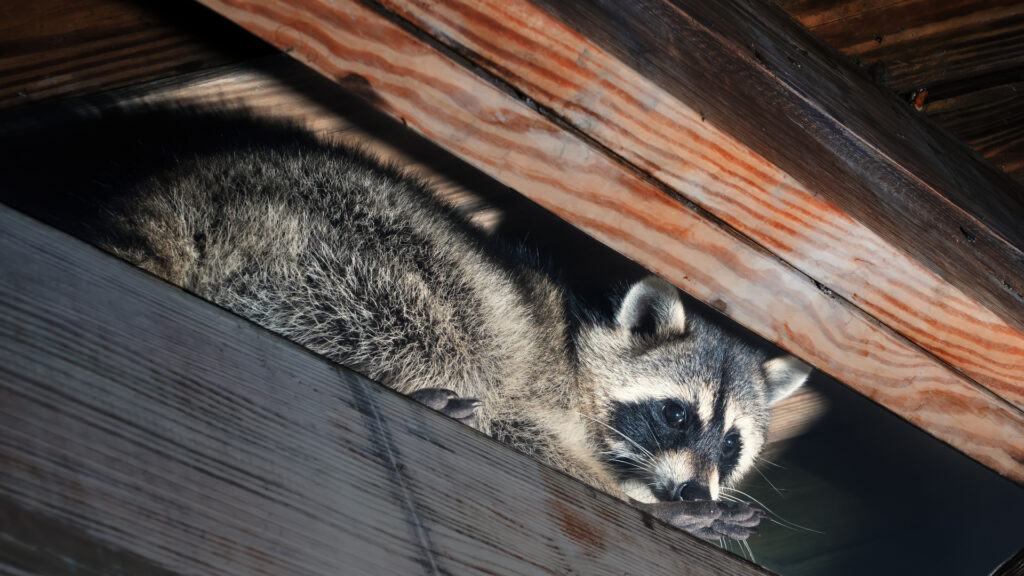
Store-bought traps and online tutorials have their place, but raccoon removal from attic spaces is a situation where doing it wrong usually makes things worse. Either the animal gets relocated and another one moves in through the same gap, or a female gets separated from a litter and the young die in the wall. Neither of those is a good outcome.
Our Process From Inspection to Exclusion
Here’s what the process looks like from the first call:
- Full exterior inspection to find every entry point, not only the obvious one
- Humane trapping with check-ins to minimize stress and time in the trap
- Attic inspection to assess damage, confirm whether a litter is present, and document the full scope
- Exclusion work to seal all entry points with materials that hold, not foam or mesh that another animal can work through
We don’t do a catch-and-release that leaves the gap open. The whole job means the animal is out and the entry is sealed. For homeowners dealing with a female raccoon and young, we handle the family unit together; separating them creates a second problem while the first one is still unresolved.
Once everything is cleared and sealed, we’ll walk you through what we found so you’re not left guessing about the condition of the attic. If you’ve got bats sharing the space, which happens in older homes with multiple roofline gaps, our bat removal service runs on the same exclusion-based approach and can sometimes be handled in the same visit.
Squirrels use similar entry points and show up in the same spaces. Our squirrel removal service handles those cases using the same exclusion process.
What to Do Before We Arrive
If you’re confident there’s a raccoon in your attic, the instinct to investigate makes sense. A few things to keep in mind before we get there:
- Don’t open the attic hatch without a mask; disturbing droppings without protection is a real exposure risk
- Don’t block the entry point yourself; if a raccoon is inside when the gap gets sealed, you’ve created a different problem
- Note the times you’re hearing activity; this helps us confirm species and plan trapping timing
Our raccoon removal services page has more on how we handle different scenarios, but if you’re already hearing something overhead every night, the fastest path forward is giving us a call.
Call Us for Raccoon Removal in Omaha
A raccoon in your attic won’t leave on its own. The longer they’re up there, the more damage builds, and if a female is raising young, the timeline gets complicated fast. If you’re in the Omaha area, call us at (402) 300-8168 or request a free estimate through our Omaha location page.
We serve homeowners across the region, including:
